
Opportunity Zones in Fort Lauderdale
Fort Lauderdale has ten Opportunity Zones today. On January 1, 2027, a brand-new federal map takes effect — and only two of the ten carry into it. I'm Sean Strahler — Sailboat Bend and Fort Lauderdale specialist — a Real-ativity agent who lives there — and this page explains what changed, which areas are affected, and why the end of 2026 matters if you're thinking about investing in the outgoing zones.
Intelligent real estate, personally delivered.
What is an Opportunity Zone?
An Opportunity Zone is a census tract — a defined neighborhood-sized area — that the federal government has designated for a tax incentive. Investors who put capital gains into a Qualified Opportunity Fund and invest that money in property or businesses inside a designated tract can defer the tax on those gains, and investments held long enough can receive additional tax benefits. The idea is simple: steer private investment toward areas that haven't seen as much of it.
Two things are worth knowing. First, the designations are public federal data — the tract lists and the official map are published by the U.S. Treasury and the CDFI Fund for anyone to check. Second, the zones are redrawn on a cycle: states nominate tracts, and the Treasury certifies the final list. That redrawing is exactly what just happened.
The big change: a new national map for 2027
On November 5, 2026, the U.S. Treasury and the IRS designated the new national Opportunity Zone map: 6,576 census tracts across all 50 states, the territories, and Washington, D.C. Florida received the maximum it was allowed — 342 tracts. The new zones take effect January 1, 2027 and remain designated for ten years, through December 31, 2036.
This is not a light refresh of the old map. States went back to the full list of eligible tracts and chose again — and in many places, including Fort Lauderdale, they chose very differently.
Fort Lauderdale: ten zones today, two going forward
An Opportunity Zone is a specific area on a map. The government draws the boundaries using census tracts — statistical areas that each cover a few neighborhoods' worth of blocks — and the tax benefit attaches to property inside the lines. Fort Lauderdale's current zones were designated in 2018. There are ten of them, all clustered in the northwest side of the city and around the Sistrunk corridor, just north and west of downtown.
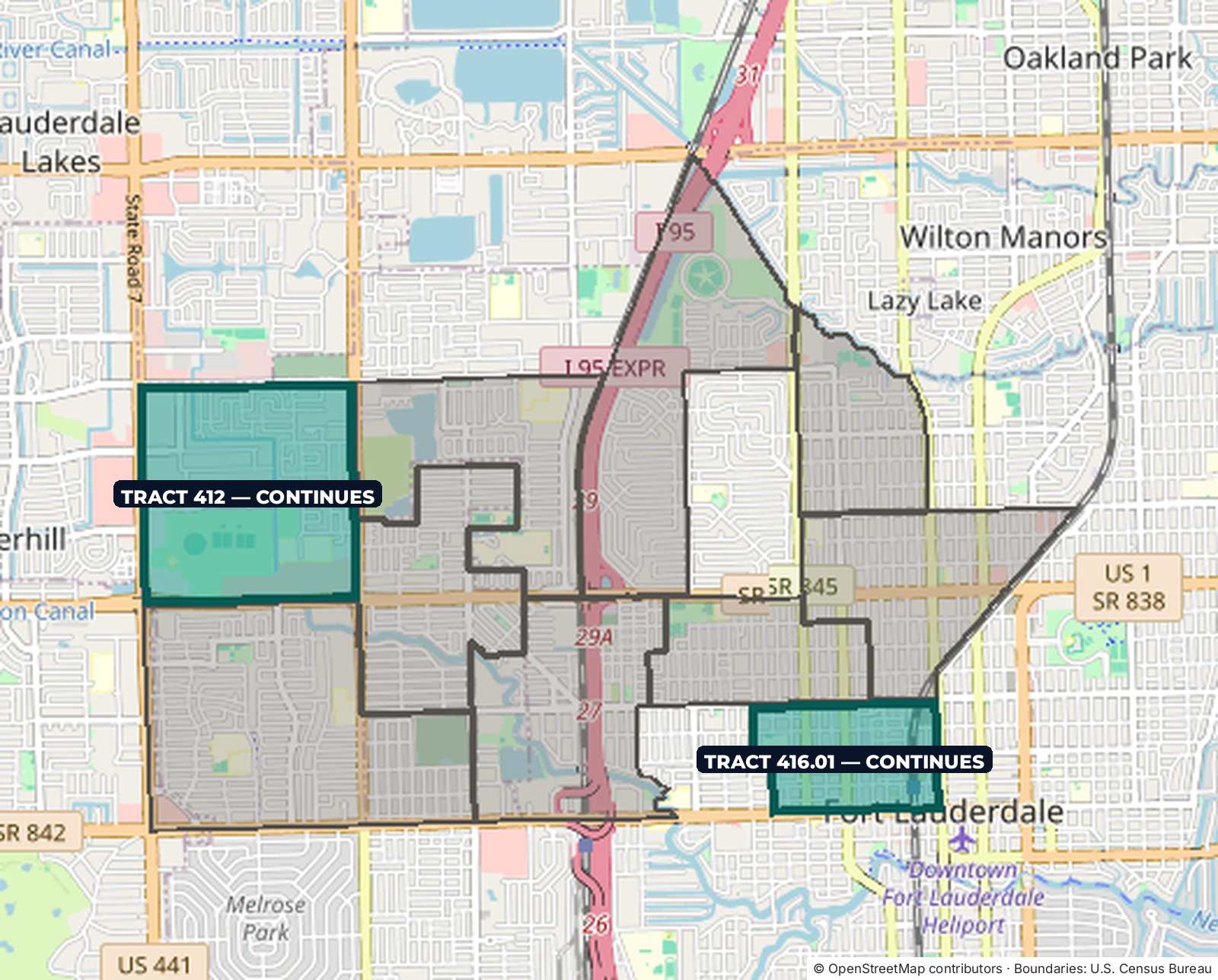
On the new map, only two of the ten zones continue. In plain terms, they are:
West of I-95, along Sistrunk Boulevard
Roughly from NW 31st Avenue west past Powerline Road toward the city limits, and from just north of Sistrunk Boulevard (NW 6th Street) up to about NW 19th Street — the Washington Park and Roosevelt Gardens area. (Officially: census tract 412.) Designated again for 2027–2036.
Just north of downtown
Broward Boulevard north to Sistrunk Boulevard, between NW 9th Avenue (Dr. Martin Luther King Jr. Boulevard) and Andrews Avenue — the Progresso Village area. (Officially: census tract 416.01 — the eastern part of the old tract 416, which the 2020 census split in two; the western piece, 416.02, was not redesignated.) Designated again for 2027–2036.
The other eight zones fill in the rest of the gray area on the map — Dorsey Riverbend on both sides of I-95, the Sistrunk corridor east of the highway, the rest of Progresso Village and Flagler Village up to and just north of Sunrise Boulevard, and the blocks west of I-95 below Sistrunk. They were eligible for the new map but were not selected, and no new Fort Lauderdale zones were added. So on January 1, 2027, the city's Opportunity Zone footprint shrinks from ten zones to the two teal ones.
For official documents, the ten current tracts are 408.01, 409.01, 410, 411, 412, 413, 414, 415, 416, and 417; the two continuing are 412 and 416.01.
What this means if you own property — or are thinking of investing — in the outgoing zones
If you already made an Opportunity Zone investment in one of the outgoing tracts, don't panic: investments already in place keep the benefits they were made under. The change is about new investments.
Under the IRS transition guidance (Notice 2026-40), property acquired after December 31, 2026 in a tract that was not redesignated generally will not qualify as Opportunity Zone property. The 2018 designations formally run through December 31, 2028, but for a new purchase the practical deadline in the outgoing Fort Lauderdale tracts is the end of 2026 — that's when the window for starting a new qualifying investment there effectively closes.
For owners in those areas, the takeaway is more modest: the zone designation was one factor supporting investor interest nearby, and that factor steps down in 2027. It doesn't change your property taxes, your zoning, or your ability to sell — and the city's own redevelopment investment in the same neighborhoods continues through its Community Redevelopment Areas, which are a separate, city-run program.
Broward County's new map
Broward County has 21 tracts on the new map, spread across the county — Coral Springs (tract 102.02), the Pompano Beach area (304.02, 507.02, 508), Fort Lauderdale (412, 416.01), the Lauderhill and Lauderdale Lakes area (601.17, 602.03, 602.08, 701.04, 801.02, 805), Hollywood (903.01, 903.03, 905.04, 911, 914, 919.03), and Pembroke Pines and Miramar (1001.03, 1002.01, 1003.02).
Only a handful of those are holdovers from the current map — most of Broward's 2027 zones are new selections, which tells you how thoroughly the state redrew its list. If you're evaluating a specific property, the tract is what matters: check the address against the official map before assuming anything about eligibility.
See it for yourself
- CDFI Fund — Opportunity Zones resources (the official designated-tract list and map; the CDFI Fund supports the designation process for the Treasury and IRS)
- U.S. Treasury — "Treasury, IRS Announce Opportunity Zones Designations" (November 5, 2026)
General information only — this page is not tax or investment advice, and Opportunity Zone rules have detailed requirements and deadlines. If you're considering an Opportunity Zone investment, talk with a qualified tax professional before you act.
Questions about the zones?
Own property in one of the outgoing tracts, or looking at an investment in the northwest or downtown areas? I'm happy to talk through what the new map could mean for your street — and I follow the city's redevelopment meetings as these areas change.
Sean Strahler, Real-ativity
Phone: (412) 897-0023
Email: SeanStrahler@Real-ativity.com
Florida Sales Associate · License SL3647352
Find me: Facebook | YouTube | Real-ativity | Leave a Google review
Agent profiles: Zillow | Realtor.com | Homes.com
Intelligent real estate, personally delivered.